The Structural Transformation of British Data Autonomy: A Comprehensive Analysis of the Data (Use and Access) Act 2025
The Strategic Reorientation of the UK Data Protection Regime
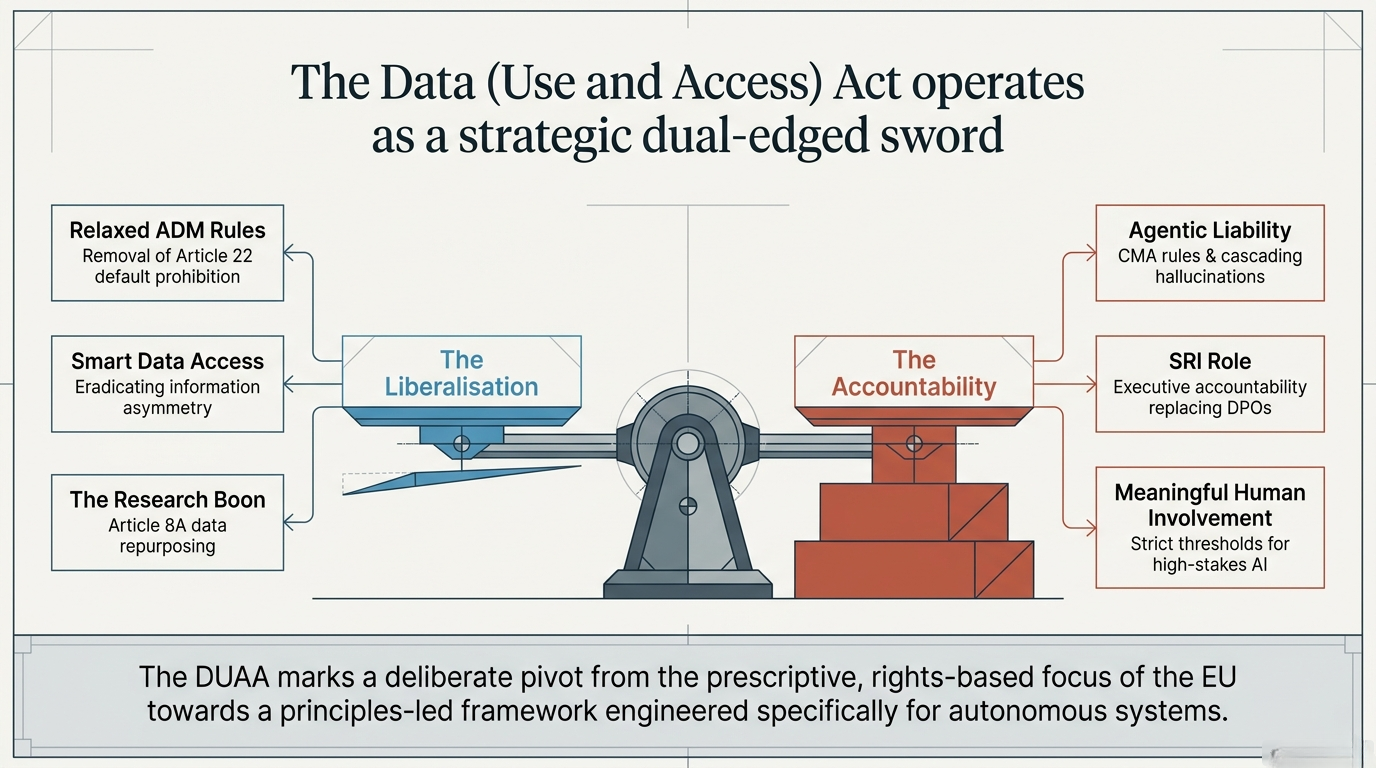
The enactment of the Data (Use and Access) Act 2025 (DUAA), which received Royal Assent on 19 June 2025, represents the most significant overhaul of the United Kingdom’s digital information framework since the adoption of the General Data Protection Regulation (GDPR). This legislative milestone marks the formal conclusion of a multi-year effort to deviate from the prescriptive, rights-based focus of European Union data law in favor of a principles-led, pro-innovation model specifically engineered for an economy increasingly dominated by artificial intelligence (AI) and autonomous systems. For businesses heavily reliant on AI—particularly those deploying agentic systems that provide direct consumer advice, interactive services, and automated tools—the DUAA provides a more permissive operational environment while simultaneously introducing rigorous new structures for executive accountability and consumer protection.
The implementation of the DUAA is structured across a phased timeline, with the most critical reforms to the UK GDPR and the Data Protection Act 2018 entering into force on 5 February 2026. This phase, often referred to as Stage 3 of the commencement plan, activated the core provisions relating to automated decision-making (ADM), the introduction of "recognised legitimate interests," and the modernization of international data transfer tests. A subsequent significant milestone is scheduled for 19 June 2026, when Section 103 mandates the implementation of formal, internal complaints procedures for all data controllers, marking a shift toward self-regulation backed by robust enforcement powers.
| Implementation Milestone | Effective Date | Regulatory Impact Area |
|---|---|---|
| Royal Assent | 19 June 2025 | Immediate effect for SAR "reasonable searches" and biometric retention |
| Phase 2 Commencement | 6 February 2026 | Criminalization of non-consensual deepfake creation |
| Main Reform Phase | 5 February 2026 | Relaxation of ADM rules, Recognised Legitimate Interests, Data Bridge tests |
| Statutory Complaints | 19 June 2026 | Mandatory internal grievance mechanisms and 30-day response duty |
| Regulatory Transition | Throughout 2026 | Restructuring of the ICO into the Information Commission (IC) |
The genesis of this Act lies in the transition from the previously proposed Data Protection and Digital Information Bill (DPDIB) to the current DUAA framework. While the DUAA retains much of the pro-innovation sentiment of its predecessor, it introduces more refined safeguards for children and a clearer focus on the deployment of "Smart Data" schemes, designed to facilitate interoperability and data portability across sectors like finance and energy. This evolution reflects a nuanced understanding of the causal relationship between data accessibility and AI performance: as agentic systems require broader access to datasets to function autonomously, the law must balance this access with mechanisms that prevent systemic bias and protect consumer agency.
The Liberalization of Automated Decision-Making and Algorithmic Governance
The pivot point for AI-reliant businesses under the DUAA is the fundamental restructuring of the rules governing automated individual decision-making (ADM). Previously, Article 22 of the UK GDPR established a default prohibition on decisions made solely through automated processing that produced "legal or similarly significant effects" on individuals, unless specifically authorized by contract, law, or explicit consent. The DUAA largely removes this prohibition for processing activities that do not involve "special category" data, such as health information, ethnic origin, or biometric identifiers.
This change enables organizations to deploy AI for a wide range of significant decisions—including recruitment shortlisting, credit scoring, insurance risk assessment, and eligibility for essential services—relying on a broader array of lawful bases, most notably the "legitimate interests" of the controller. The implications for interactive AI tools and advice services are profound: where a chatbot or automated advisor once required a complex web of explicit consents to finalize a service contract or provide high-stakes financial guidance, it can now operate under a more fluid legitimate interest framework, provided that the system architecture includes specific, operationalized safeguards.
Defining Significance and the Threshold of Meaningful Human Involvement
The DUAA clarifies the definitions of "significant decisions" and "meaningful human involvement," which serve as the boundary markers for regulatory compliance. A decision is classified as significant if it produces a legal effect or has a similarly substantial impact on an individual’s circumstances, such as their financial standing, reputation, health, or employment opportunities. Routine activities—such as content recommendations on a streaming platform or the prioritization of low-stakes customer service tickets—generally fall outside these more rigorous requirements.
However, the distinction between a "solely" automated decision and one with "meaningful human involvement" is critical. The Act stipulates that a decision is solely automated if there is no meaningful human involvement in the final determination. To qualify as "meaningful," the human intervention must be more than a mere "token gesture"; the reviewer must possess the actual authority and discretion to alter the machine’s determination based on their own evaluation of the data.
| Safeguard Pillar | Statutory Requirement | Operational Implementation for AI Firms |
|---|---|---|
| Transparency | Provide info about the use of ADM | Plain-language disclosure in the chatbot interface or portal |
| Representation | Enable subjects to make representations | Dedicated input fields for users to explain their context |
| Human Intervention | Offer a route to meaningful review | Escalation protocols to trained human agents with override power |
| Contestation | Allow individuals to contest the decision | Formal appeal processes within the digital service workflow |
For businesses providing AI-driven advice, this means that while the AI can generate the primary recommendation or decision, a human must be "in the loop" for higher-stakes outcomes to avoid the most restrictive ADM classifications. The Information Commission is expected to publish expansive guidance on the technical thresholds of "meaningful involvement" in Spring 2026, which will likely require firms to document the exact stage and depth of human review in their automated workflows.
Consumer Protection and the Liability of Agentic AI
As AI systems move toward "agency"—the ability to act autonomously in pursuit of high-level goals—the regulatory focus has expanded to include the interaction between AI and consumer protection law. In March 2026, the Competition and Markets Authority (CMA) issued definitive guidance stating that businesses remain fully responsible for the actions, statements, and errors of their AI agents, regardless of whether the technology was developed in-house or supplied by a third party. This removes any ambiguity regarding algorithmic liability: if an AI chatbot providing financial advice makes a misleading claim or enters into an unfair contract, the deploying business is liable as if a human employee had committed the infraction.
This liability framework is underpinned by the Consumer Rights Act 2015 and the Digital Markets, Competition and Consumers Act 2024. The CMA has identified specific risks inherent in agentic AI that businesses must mitigate to avoid enforcement action, which can include fines of up to 10% of global annual turnover. These risks include "cascading hallucinations," where an agent makes a probabilistic error that leads to nonsensical or harmful consumer outcomes, and "manipulative design," where an AI system dynamically optimizes its interaction to pressure consumers into making decisions they otherwise would not have made—a digital evolution of "dark patterns".
Professional Liability and the Duty of Care
The UK Jurisdiction Taskforce (UKJT) has further clarified the intersection of AI and common law. Since AI lacks legal personality under English law, liability for harm must be attributed to legal persons using ordinary principles of negligence. This requires a five-part test: the presence of a duty of care, a relevant standard of care, a failure to meet that standard, causation of loss, and foreseeability of that loss.
For professionals providing services via AI (e.g., automated legal or medical triage), a failure to conduct proper due diligence on the AI system before deployment is likely to constitute a breach of duty. Furthermore, a professional can now be held liable for a failure to use AI if a reasonable professional in that field should have utilized the technology to ensure accuracy or safety. This "double-edged sword" of liability forces AI-reliant firms to maintain a state-of-the-art understanding of both the capabilities and the risks of the tools they deploy.
| Liability Factor | Risk for AI-Driven Advice Services | Mitigation Strategy |
|---|---|---|
| Vicarious Liability | Firm is responsible for agent's "hallucinations" | Robust unit testing and prompt engineering guardrails |
| Duty of Care | Negligent selection of an untested AI model | Third-party vendor audits and technical documentation |
| Transparency | Misleading consumers into thinking AI is a human | Clear disclosure of AI status and model limitations |
| Data Minimization | Agent over-scoping data access for performance | Strict configuration of agent access permissions |
Institutional Restructuring: The Information Commission and Executive Accountability
The DUAA transforms the regulatory architecture of the UK by restructuring the Information Commissioner’s Office into a corporate body known as the Information Commission (IC). This transition, scheduled to stabilize throughout 2026, moves the UK toward a multi-member governance model designed to ensure more consistent and predictable regulatory decision-making. The IC is legally mandated to "have regard to" promoting innovation and competition, signaling a departure from the purely enforcement-focused stance of some European counterparts.
Accompanying this institutional change is the introduction of the "Senior Responsible Individual" (SRI) role, which replaces the Data Protection Officer (DPO) for all UK data controllers. This change is not merely cosmetic; the SRI must be a senior manager with the authority to ensure that data protection is embedded into the organization’s core business strategy. For AI startups and established tech firms alike, this shift increases executive accountability for high-risk processing activities.
Expanded Enforcement and Investigative Powers
The Information Commission has been granted significant new powers to investigate the "black box" of AI systems. These include the authority to issue "interview notices," compelling witnesses to provide information, and "assessment notices," which can require a controller to commission an independent technical report on their AI systems at their own expense.
Furthermore, the maximum penalties under the Privacy and Electronic Communications Regulations (PECR)—which govern cookies and direct marketing—have been aligned with UK GDPR levels, rising from £500,000 to up to £17.5 million or 4% of global turnover. For interactive AI tools that utilize cookies for personalization or track user behavior to refine advice models, this increased penalty threshold necessitates a rigorous review of consent mechanisms and tracking technologies.
The Research Boon and the Expansion of Smart Data
For businesses that rely on large-scale data processing to train and refine AI models, the DUAA introduces two critical enablers: a modernized framework for scientific research and the introduction of "Smart Data" schemes. The Act broadens the statutory definition of "scientific research" to include commercial and privately funded research and development, essentially legitimizing the data-intensive activities of AI labs.
Under the new Article 8A of the UK GDPR, processing personal data for research purposes is treated as compatible with the original purpose for which the data was collected. This allows AI firms to repurpose existing datasets for model training without needing to provide a new privacy notice, provided that doing so would involve "disproportionate effort". Furthermore, "broad consent" provisions allow data subjects to consent to their data being used for a general "area" of research, acknowledging that the precise future utility of data in AI training is often unknown at the point of collection.
Smart Data Schemes and Data Portability
Part 1 of the DUAA empowers the government to introduce Smart Data schemes across the economy, modeled on the success of Open Banking. These schemes will mandate the secure sharing of customer and business data with authorized third parties, facilitating real-time data portability. For AI developers providing personal finance tools, energy management advisors, or switching services, this creates a statutory pipeline of high-quality, verified data.
| Smart Data Component | Regulatory Mechanism | Benefit for AI Service Providers |
|---|---|---|
| Mandatory Interfaces | Prescribed API standards for sharing | Reliable, structured data for model inputs |
| Third-Party Access | Authorized representative access | Seamless integration for personalized AI tools |
| Cross-Sector Powers | Powers beyond finance/energy | Holistic view of consumer behavior for agentic AI |
| Technical Standards | Ability to update specs via secondary legislation | Agility in a fast-paced technical environment |
These schemes are intended to "rebalance the information asymmetry" between incumbent service providers and consumers, allowing AI-driven challengers to offer highly personalized, data-backed advice that was previously restricted by data silos.
Operationalizing Compliance: Subject Access, ROPAs, and DPIAs
The DUAA introduces pragmatic changes to the day-to-day operations of data compliance, designed to reduce the administrative burden on businesses while maintaining robust standards. For organizations managing interactive AI tools, the Subject Access Request (SAR) process has often been a source of significant friction. The Act codifies the "reasonable and proportionate" search standard, clarifying that firms are not required to conduct exhaustive, resource-draining searches in response to speculative requests.
A critical operational change is the "stop the clock" rule. If a business reasonably requires more information from a requester to fulfill a SAR, the one-month response timer is paused until that information is received. This provides a vital safeguard for AI firms that may receive complex requests relating to "all data used to profile me," allowing for technical clarification without the risk of missing statutory deadlines.
Assessment of High-Risk Processing and ROPAs
While the DUAA streamlines many processes, it reinforces the need for accountability through updated Records of Processing Activities (ROPA) and "Assessments of High Risk Processing"—the UK’s evolution of the Data Protection Impact Assessment (DPIA). Organizations relying on AI must ensure that their ROPAs accurately reflect the "Recognised Legitimate Interests" they may be utilizing, such as those for crime prevention or safeguarding.
For AI firms interacting with children, the DUAA introduces a new "children’s higher protection matters" duty. When designing online services likely to be accessed by children, firms must take into account their specific needs and developmental stages, essentially codifying the ICO’s "Children’s Code" into statutory requirements. Failure to account for these matters in a DPIA/High-Risk Assessment may now be treated as a direct breach of "data protection by design" obligations.
Global Geopolitical Strategy and the AI Growth Lab
The UK’s regulatory strategy is characterized by a desire to be the "best place in the world to test" AI. A central pillar of this ambition is the "AI Growth Lab," a cross-economy regulatory sandbox that allows businesses to test innovative AI products in real-world conditions with the potential for temporary regulatory modifications. This initiative aims to address the "regulatory barriers" that currently stifle the deployment of cutting-edge systems, providing a structured pathway for experimental pilots to become permanent regulatory reforms.
However, this pro-innovation stance must be balanced against the necessity of maintaining "adequacy" with the European Union to ensure the continued flow of data across the English Channel. The DUAA introduces a new "data protection test" for international transfers, requiring that third countries maintain a standard of protection that is "not materially lower" than that of the UK. While this provides more flexibility than the EU’s "essential equivalence" test, it creates a potential point of divergence that the European Commission will closely monitor.
| Jurisdiction | Regulatory Philosophy | Primary Enforcement Focus |
|---|---|---|
| UK (DUAA 2025) | Principles-based, sectoral, and contextual | Innovation, consumer choice, and accountability |
| EU (AI Act) | Risk-based, horizontal, and prescriptive | Safety, fundamental rights, and technical standards |
| US | Voluntary frameworks and sectoral guidance | National security, competition, and trust |
UK businesses must navigate this "dual-compliance" reality: while the DUAA offers operational flexibility within the British market, any interaction with the EU market will necessitate compliance with the EU AI Act, which carries its own set of stringent requirements for "high-risk" systems, including conformity assessments and post-market monitoring.
Future Outlook: Navigating the 2026 Regulatory Landscape
As the UK moves toward full implementation of the DUAA by mid-2026, the landscape for AI-reliant businesses will be defined by the transition from compliance-as-a-cost to compliance-as-a-competitive-advantage. The shift toward agentic AI necessitates a more sophisticated understanding of both data protection and consumer law, as the "autonomous drift" of these systems can quickly lead to systemic legal exposure.
The Information Commission’s forthcoming guidance in 2026 will be the definitive roadmap for organizations. Firms that proactively adopt "privacy-by-design" and "consumer-protection-by-design" will be better positioned to leverage the benefits of Smart Data and the AI Growth Lab. The era of "meaningful human involvement" requires a reimagining of the workforce, where humans are not just operators of AI, but vital supervisors ensuring the ethical and legal integrity of autonomous systems. Ultimately, the success of the DUAA will be judged by its ability to foster an ecosystem where consumers trust AI-driven advice as much as they trust human expertise, underpinned by a regulatory framework that is as dynamic as the technology it oversees.
Self-Assessment Tool
Identify your regulatory exposure. This brief 5-step diagnostic will help you determine if your current AI workflows meet the Data (Use and Access) Act 2025 standards.
Does your business use AI or automated systems to make decisions about customers (e.g., pricing, eligibility, or hiring)?
Have you appointed a Senior Responsible Individual (SRI) within your board or management team for data protection?
When AI makes a decision, is there meaningful human involvement with actual override power?
Do you have a formal, documented 30-day internal complaints procedure for data grievances?
Are your human-interaction standards across Phone, Digital, and Physical channels formally self-certified?
Reviewing Analysis...
Our diagnostic shows several gaps in your "Human-in-the-Loop" architecture and executive accountability structure.
Compliance Briefing
Key questions regarding the Data (Use and Access) Act 2025 and your business.
The primary shift is from a prescriptive, "one-size-fits-all" approach to a principles-led model. While core data rights remain, the DUAA relaxes the prohibition on automated decision-making (ADM) for non-sensitive data and introduces "Recognised Legitimate Interests" to simplify the lawful basis for common business processing tasks like crime prevention and safeguarding.
The role of the DPO is being replaced by the Senior Responsible Individual (SRI). Unlike the DPO, who was often a third-party advisor, the SRI must be a member of the organization’s senior management team. This ensures that data protection is a board-level priority and that the individual responsible has the authority to effect real change within the business.
If your AI makes a "significant decision" (e.g., denying credit or a service contract), the law requires meaningful human involvement to avoid the strict ADM penalties. This means a human must have the authority to override the AI’s decision. For certified Human-First businesses, our standards ensure your systems meet these "human-in-the-loop" requirements by default.
Penalties for direct marketing breaches (PECR) have been significantly increased to match GDPR levels: up to £17.5 million or 4% of global annual turnover. Furthermore, the restructured Information Commission has new powers to compel interviews and demand independent technical audits of your AI systems.
At LiveInTheRealWorld.com, we utilize a self-certification model. There are no invasive or resource-draining audits. You certify that your business adheres to our 3 Pillars of Humanity. This certification signals to consumers and regulators alike that you prioritize human oversight—a key requirement for demonstrating "meaningful involvement" under the 2025 Act.
"The shift toward the Senior Responsible Individual (SRI) model marks the end of compliance being a 'tick-box' exercise. It is now a core operational mandate."
Secure Your Certification TodayApply for Certification
Select your path: Self-certify your own business, or become a Partner and monetize the movement.
Operating a Franchise, Agency, or Multi-Branch Network?
Discover our Corporate & Partner Certification Tiers to cover your entire footprint.
View Enterprise Packages
Request Received
Your self-certification details have been securely logged. A member of our team will contact you shortly to complete the setup process.